
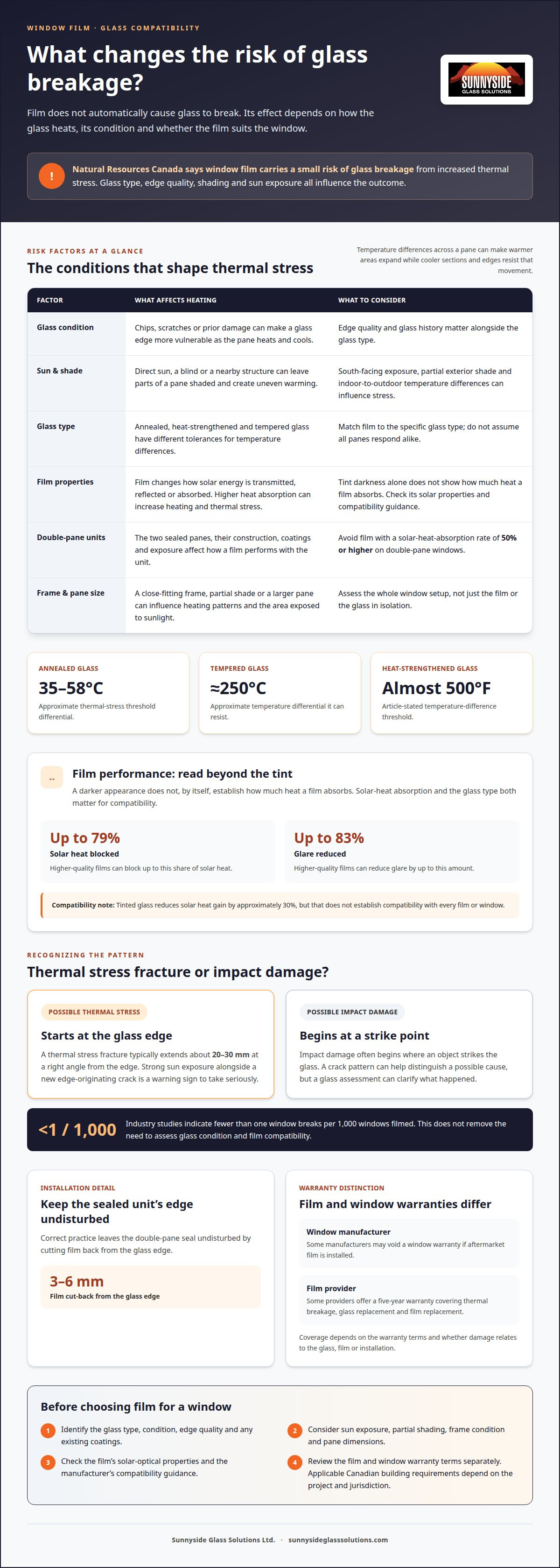
Will Window Film Cause Glass to Break? Understanding the Risk

Window film does not automatically cause glass to break, but it can increase thermal stress. If you’re asking, “Will window film cause my glass to break?”, the answer depends on the glass, its condition and how sunlight heats it. Natural Resources Canada says window film carries a small risk of glass breakage.
That concern is understandable with double-pane windows, where an unsuitable film can contribute to heat building between panes and stress the glass or its edges. Whether window film will cause your glass to break depends on factors such as glass type, frame condition, existing shading and sun exposure.
This article explains how these factors affect breakage risk, why film choice and installation matter, and how film can contribute to damage in double-pane glass. You’ll learn what to consider when assessing whether window film could cause your glass to break and when professional guidance can help.
Table of Contents
Glass, frame, shading, and solar exposure risk factors
Breakage risk depends on the glass edges, frame condition, shading, film type, pane dimensions and indoor-to-outdoor temperature differences. A south-facing window with damaged edges may respond differently from a shaded pane in sound condition.
Film Placement and Solar Exposure
External solar film is applied to the outside of the glass, while internal solar film is applied indoors. Placement matters because direct sunlight and existing shade affect how the glass heats. For example, a blind or nearby structure may leave part of a pane shaded, causing uneven warming. That variation can add stress, especially if the glass edge is already damaged.
Glass Types and Solar Absorption
Different glass types absorb and manage solar heat differently, so their compatibility with film matters. Annealed, heat-strengthened, and tempered glass have different tolerances for temperature differences. Heat-strengthened glass has a temperature-difference threshold of almost 500 degrees Fahrenheit. Glass history and edge quality also count: chips, scratches, or prior damage can make an edge more vulnerable as the pane heats and cools.
Tint, Heat Absorption, and Solar Control
Tint darkness and solar-heat absorption describe different aspects of film performance: a darker appearance doesn’t alone establish how much heat the film absorbs. How do film type, tint darkness, and heat absorption affect glass breakage? A film with higher heat absorption can increase heating and thermal stress, while the glass type and exposure shape the risk. For double-pane windows, avoid film with a solar-heat-absorption rate of 50 percent or higher. Higher-quality films can block up to 79% of solar heat and reduce glare by up to 83%.
Frames, shading, and pane size further influence heating patterns. A close-fitting frame or partial exterior shade can create uneven exposure, while a larger pane has more area affected by sunlight. Tinted glass reduces solar heat gain by approximately 30%, but that figure doesn’t establish compatibility with every film or window. Manufacturers’ film compatibility guidance should account for the specific glass and its solar properties.
Will Window Films Cause Glass to Break?
Temperature differences across a pane create thermal stress, and film can change how sunlit glass heats. In Canada, thermal compatibility and applicable building requirements are separate considerations.
Temperature Differences and Thermal Stress
Thermal stress develops when one area of glass heats or cools faster than another. The warmer area expands, while cooler sections and edges resist that movement, placing the pane under strain. Annealed glass has an approximate thermal-stress threshold of 35-58°C differential. Natural Resources Canada notes that window film carries a small risk of glass breakage from increased thermal stress, so temperature patterns matter alongside glass type.
Thermal Stress Fractures
A thermal stress fracture typically starts at the glass edge and extends about 20-30 mm at a right angle from it. That pattern differs from impact damage, which often begins where an object strikes. Industry studies indicate fewer than one window breaks per 1,000 windows filmed. A crack beginning at an edge, particularly after strong sun exposure, is a warning sign worth taking seriously.
Film’s Effect on Thermal Stress
Film changes how solar energy is transmitted, reflected, or absorbed, which can increase glass heating and stress. Toughened, or tempered, glass resists temperature differentials up to approximately 250°C; annealed glass has a lower threshold. Glass condition, edge quality, pane size, shading, and indoor-to-outdoor temperature differences also influence the outcome. Film applied according to manufacturer specifications cannot be the sole cause of thermal glass breakage, but compatibility still matters.
Installation Mistakes and Breakage
Using film that doesn’t suit the glass, overlooking edge damage, or disturbing a double-pane unit’s seal can increase problems after installation. Correct practice leaves the seal undisturbed by cutting film 3-6 mm back from the glass edge. For Canadian homes, applicable building requirements depend on the project and jurisdiction; thermal compatibility alone doesn’t establish code compliance. If glass cracks, keep people clear of the pane, avoid pressing on it, and arrange a glass assessment. A new edge-originating crack signals possible thermal stress, while a visible impact point suggests another cause.
Why Do Some People Think Window Film Harms Double-Pane Windows?
A double-pane window has two sealed glass panes with a space, usually filled with gas, between them. The key concern is whether the chosen film is suitable for that glazing and sealed unit.
Film Compatibility with Double-Pane Windows
Compatibility means matching a film’s solar-optical properties to the glass type and construction. A suitable match helps manage heat absorption without adding inappropriate thermal stress to the unit. Double-pane glass is not one uniform product: pane type, existing coatings, exposure and condition all affect the assessment.
Warranty coverage varies. Some window manufacturers may void a window warranty if aftermarket film is installed, while some film providers offer a five-year warranty covering thermal breakage, glass replacement and film replacement. Responsibility depends on the warranty terms and whether the damage relates to the glass, film or installation. Those terms determine what a particular warranty covers.
That distinction is why a film warranty and a window manufacturer’s warranty should not be treated as interchangeable. One may address film-related claims, while the other concerns the original window unit.
Compatibility Evaluations and Low-E Coatings
A film-to-glass evaluation considers the glass type, the film’s solar-optical properties and the window construction before installation. This matters because a heat-absorbing film can affect a double-pane unit differently from a film designed for that glazing. An evaluation can also identify existing damage or other conditions that could affect the result.
Low-E coatings should be included in the evaluation. These thin coatings affect how a window manages heat, and their position within the unit matters when selecting compatible film. The evaluation should identify whether coated glass is present and match the film accordingly. If film is poorly matched, added heat can contribute to glass breakage or seal failure. A compatible selection considers the entire glazing system, not just the tint’s appearance.
How window film can contribute to double-pane glass breakage
Film does not automatically break double-pane glass, but an incompatible choice can change how the unit handles solar heat. The key concern is heat absorption within a sealed assembly, particularly when the film and glass combination has not been assessed together.
Does Low-E or double-pane glass automatically have a higher risk of thermal stress from window film? No. Risk depends on the glass construction, any Low-E coating, film properties, sun exposure and the glass’s condition. An unsuitable film can increase heating and stress, while a compatible selection takes the entire glazing system into account.
In a double-pane unit, two panes enclose a space that is usually filled with gas. An unsuitable window film can absorb solar heat that becomes trapped between the panes. As the glass heats unevenly, thermal stress may build, particularly at vulnerable edges. This is how film can contribute to breakage, rather than being a universal, single cause. Existing edge flaws or concentrated sunlight can add to the strain.
Installation details also matter. Correct practice leaves the edge seal undisturbed by cutting film 3-6 mm back from the glass edge. That clearance helps keep film away from the sealed perimeter. If film covers the edge or the wrong product is applied, the unit may face added stress or seal problems. The glass type and film’s solar-optical properties should be assessed before installation, not judged by tint darkness alone.
For example, a sunny window with a Low-E coating needs a film chosen for that coating and the unit’s construction. A compatibility evaluation considers these details together rather than assuming all double-pane windows behave alike. The practical takeaway is to match the film to the specific glazing and preserve the seal during installation.
Discuss film compatibility for your double-pane windows before installation.
Sunnyside Glass Solutions
Sunnyside Glass Solutions Ltd. helps homeowners assess window film needs and glass condition. Its Window Film Installation service is suited to projects where the film and glass need to work together. Sealed window unit replacement is relevant when a double-pane unit has failed or needs replacing. The next step depends on whether you’re considering film for an existing window or dealing with a damaged sealed unit.
Discussing the window’s glass type, coating, sun exposure and existing condition can clarify concerns before work begins. This context supports a practical choice based on the glazing, rather than tint appearance alone.
For guidance on a window film or sealed unit concern, contact Sunnyside Glass Solutions Ltd.
Make your next window decision with clarity
If you’re still asking, “Will window film cause my glass to break?”, let your window’s condition and construction guide the decision, not tint darkness alone. Match the film to the specific glazing and the result you want, such as managing glare or solar heat. This keeps the decision focused on the window’s needs rather than general assumptions about film.
Consider the result you want for the space, then decide whether film or attention to the glass unit is the more suitable option. If you’re planning a change, an experienced assessment can put the details into context before installation. Sunnyside Glass Solutions Ltd. provides window film installation and sealed unit replacement as part of its glass services.
Contact Sunnyside Glass Solutions Ltd. to discuss your window project and take a clear next step with confidence.
Frequently Asked Questions
Can I put window film on single glazing?
Film can be applied to single glazing when its properties suit the glass and installation conditions. Single-pane construction differs from a sealed double-pane unit, so a film intended for one type should not be assumed suitable for another. For property owners in Penticton, Kelowna, Summerland, Peachland, West Kelowna and Vancouver, the relevant details include glass type, existing damage, sun exposure and the film’s heat absorption.
Does window film void my window warranty?
Window film can affect warranty coverage, but the outcome depends on the window manufacturer’s terms. Some manufacturers may void a window warranty after aftermarket film is installed, but this is not a universal rule. Read the warranty language for conditions about alterations and film, and keep records of the window and film details. A film warranty, if provided, is separate from the original window warranty.
How is thermal stress caused?
Thermal stress occurs when parts of a glass pane change temperature at different rates. For example, a section warmed by direct afternoon sun may expand while a cooler, shaded area remains comparatively still. This difference creates strain within the pane. The level of stress depends on the glass and temperature pattern, including how exposure changes across the window during the day.
Is dark solar film safe for standard double glazing?
Darkness alone doesn’t establish whether a film suits a double-pane window. The film’s solar-heat absorption and the glazing construction both matter. Avoid films with a solar-heat-absorption rate of 50 percent or higher on double-pane windows. A compatibility evaluation should also account for any Low-E coating and the unit’s condition, since “standard” glazing can describe different glass assemblies.
Can window film cause glass to crack or break?
Yes, film can contribute to glass breakage by increasing thermal stress, but it is not automatically the sole cause. Glass condition, film compatibility, sun exposure and installation all influence the outcome. The timing of a crack alone does not establish its cause. If a pane cracks after film application, avoid putting pressure on the glass and arrange an assessment to determine whether thermal stress, impact or another issue is involved.
What types of glass are most at risk when window film is installed?
Annealed, non-toughened glass is more vulnerable to thermal stress than toughened glass, particularly if its edges are damaged or solar heating is uneven. Annealed glass has an approximate thermal-stress threshold of 35-58°C differential, while toughened glass resists differentials up to approximately 250°C. Glass type alone doesn’t determine risk; condition, shading, film properties, and exposure also affect the assessment.
Comments